
Oct 27, 2026News & Insights
Wireless Charger Over-Temperature Testing
Learn why over-temperature testing matters for wireless chargers and how Cwin verifies thermal protection, power reduction, and automatic recovery.
Wireless Charger Over-Temperature Testing: Why It Matters and How It Works?
Over-temperature protection is an important safety feature for wireless chargers. It helps prevent excessive heat from damaging electronic components and ensures the charger can safely stop and recover under high-temperature conditions.
For OEM/ODM wireless chargers, thermal protection testing is an essential step in verifying product safety, reliability, and charging stability.
Why Is Over-Temperature Testing Important?
Wireless charging generates heat during operation. Under high-load conditions, poor heat dissipation, abnormal charging conditions, or high ambient temperatures may cause the internal temperature to rise excessively.
Effective over-temperature protection can:
- Prevent overheating and component damage
- Reduce potential safety risks
- Protect the charging circuit and PCB
- Improve product reliability and service life
- Ensure safe recovery after the temperature returns to a normal level
How Do We Test Over-Temperature Protection?
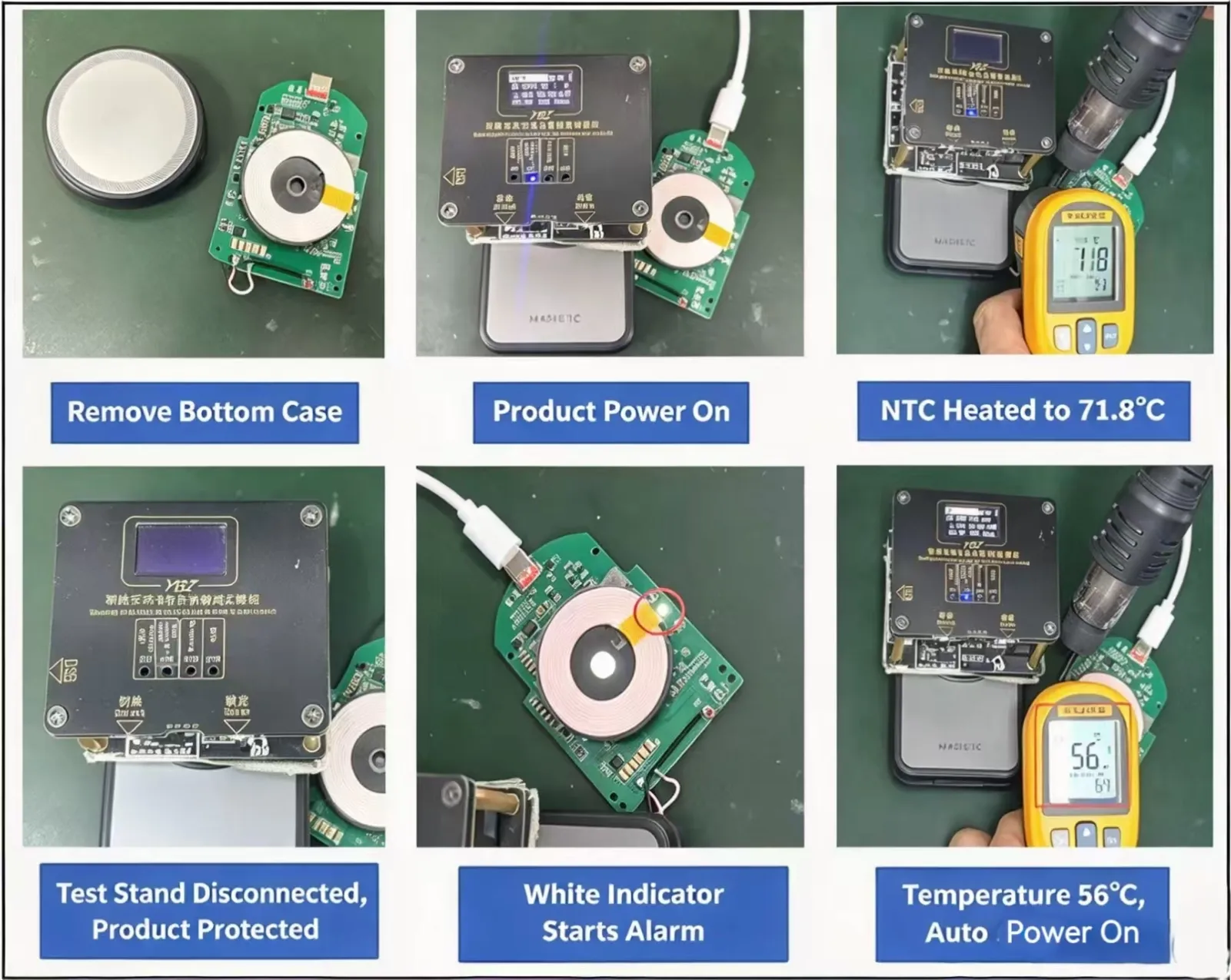
At Cwin, a typical test is performed by monitoring the NTC temperature on the PCB.
Step 1 – Prepare the Test Sample
Prepare the wireless charger sample, test fixture, heating equipment, and temperature measuring device.
Step 2 – Connect the Test Fixture
Remove the product's bottom cover, expose the PCB, install the test fixture, and power the charger under normal operating conditions.
Step 3 – Increase the Temperature
Use a controlled hot-air gun to gradually heat the NTC while continuously monitoring its temperature with a temperature meter.
Step 4 – Verify Protection and Recovery
When the NTC temperature reaches the specified protection range of approximately 60–70°C, the charger should automatically enter protection mode. The indicator provides an alarm and the charging power drops.
When the temperature decreases to approximately 40°C, the charger should automatically recover and return to normal operation.
What Makes the Test Qualified?
In a typical Cwin test, the sample automatically activated thermal protection at 63°C. The charging power decreased as expected, and normal power automatically recovered when the temperature dropped to approximately 46°C.
Test Result: PASS
A qualified wireless charger should be able to detect excessive temperature, reduce or stop power output, and automatically recover when the temperature returns to a safe range.
Thermal Protection for OEM & ODM Wireless Chargers
Cwin integrates thermal protection considerations into wireless charger design, circuit development, and product testing. Depending on the product requirements, we can help develop solutions with NTC temperature monitoring, thermal protection, heat dissipation optimization, and charging stability verification.
From design and prototype to testing and mass production, Cwin supports customized OEM/ODM wireless charging solutions for different applications.