
Oct 27, 2026News & Insights
Wireless Charger Over-Current Testing
Learn why over-current testing is important for wireless chargers and how Cwin verifies protection, stability, and safe recovery during OEM/ODM development.
Wireless Charger Over-Current Testing: Why It Matters and How It Works?
Over-current protection is an essential part of wireless charger safety testing. It helps prevent excessive current from damaging the charging circuit, electronic components, power supply, or connected devices.
For wireless charger manufacturers and OEM/ODM customers, proper over-current testing is an important step in verifying product safety, stability, and reliability.
Why Is Over-Current Testing Important?
During charging, abnormal conditions may cause the input current to rise above the designed limit. Without effective protection, excessive current can lead to:
- Component damage
- Excessive heat generation
- Charging instability
- Reduced product lifespan
- Potential safety risks
A qualified wireless charger should detect excessive current and automatically enter protection mode.
How Do We Test Over-Current Protection?
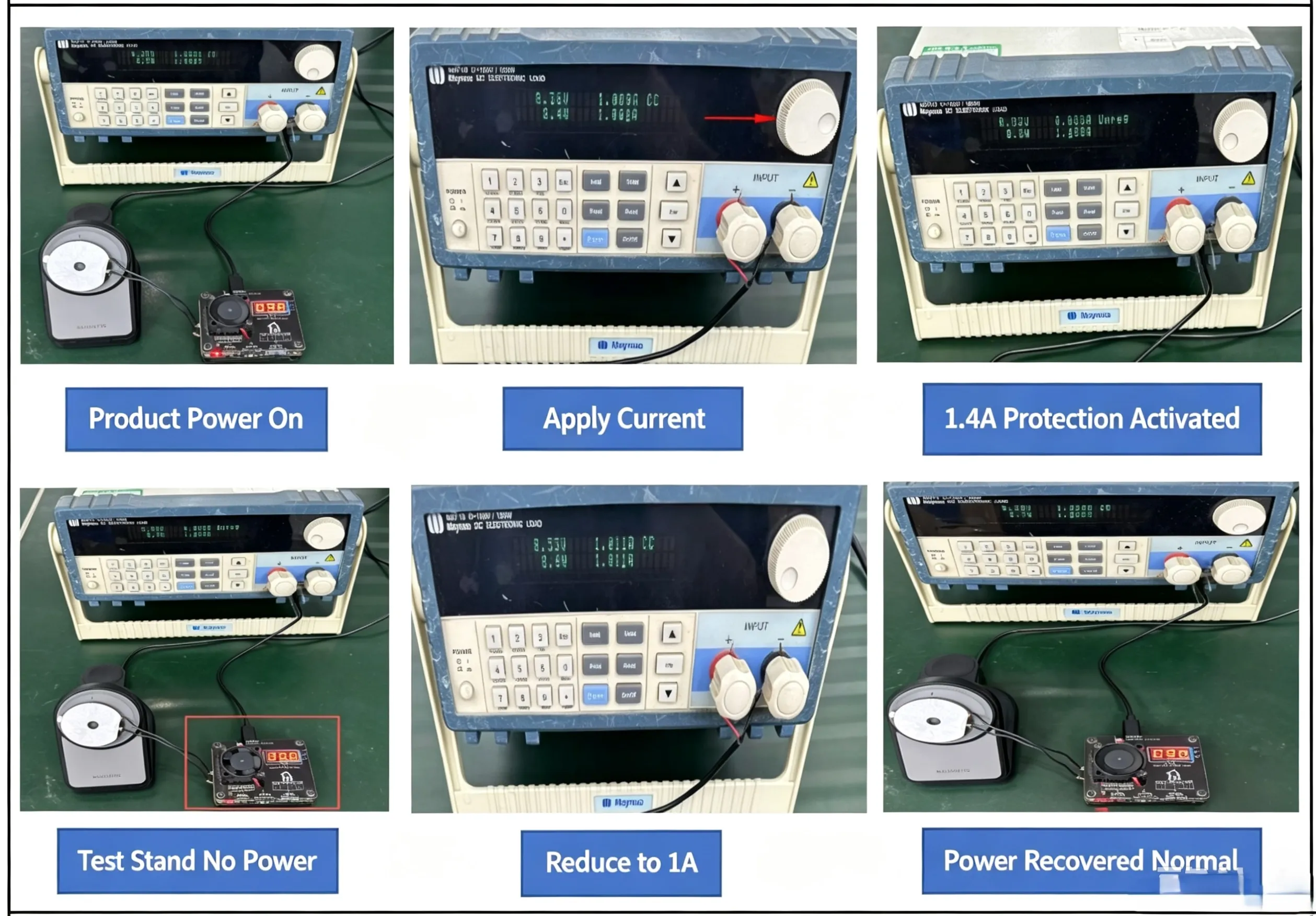
At Cwin, a typical over-current test is performed using an electronic load and test fixture.
1.Normal Operation
Set the test condition to 9V / 1A, connect the wireless charger sample to the test fixture, and verify normal operation.
2.Protection Test
Gradually increase the input current until it reaches the specified protection range of 1.3–1.5A. The charger should automatically reduce its power output and enter protection mode.
3.Recovery Test
Reduce the input current back to 1A. The charger should recover automatically and return to normal operation.
What Makes the Test Qualified?
The test is considered PASS when the wireless charger:
- Activates over-current protection within the specified range.
- Effectively limits excessive current and reduces power output.
- Prevents abnormal operation or component damage.
- Automatically recovers when the current returns to a safe level.
Reliable Testing for OEM & ODM Wireless Chargers
Over-current protection is only one part of wireless charger reliability testing. Depending on the product and application, Cwin can also support testing and verification for over-voltage, over-temperature, short-circuit protection, charging stability, thermal performance, and other product requirements.
From circuit design and prototype development to testing and mass production, Cwin provides OEM/ODM wireless charging solutions designed around your product requirements.